
The war on Waymo
Why do some progressives oppose progress?

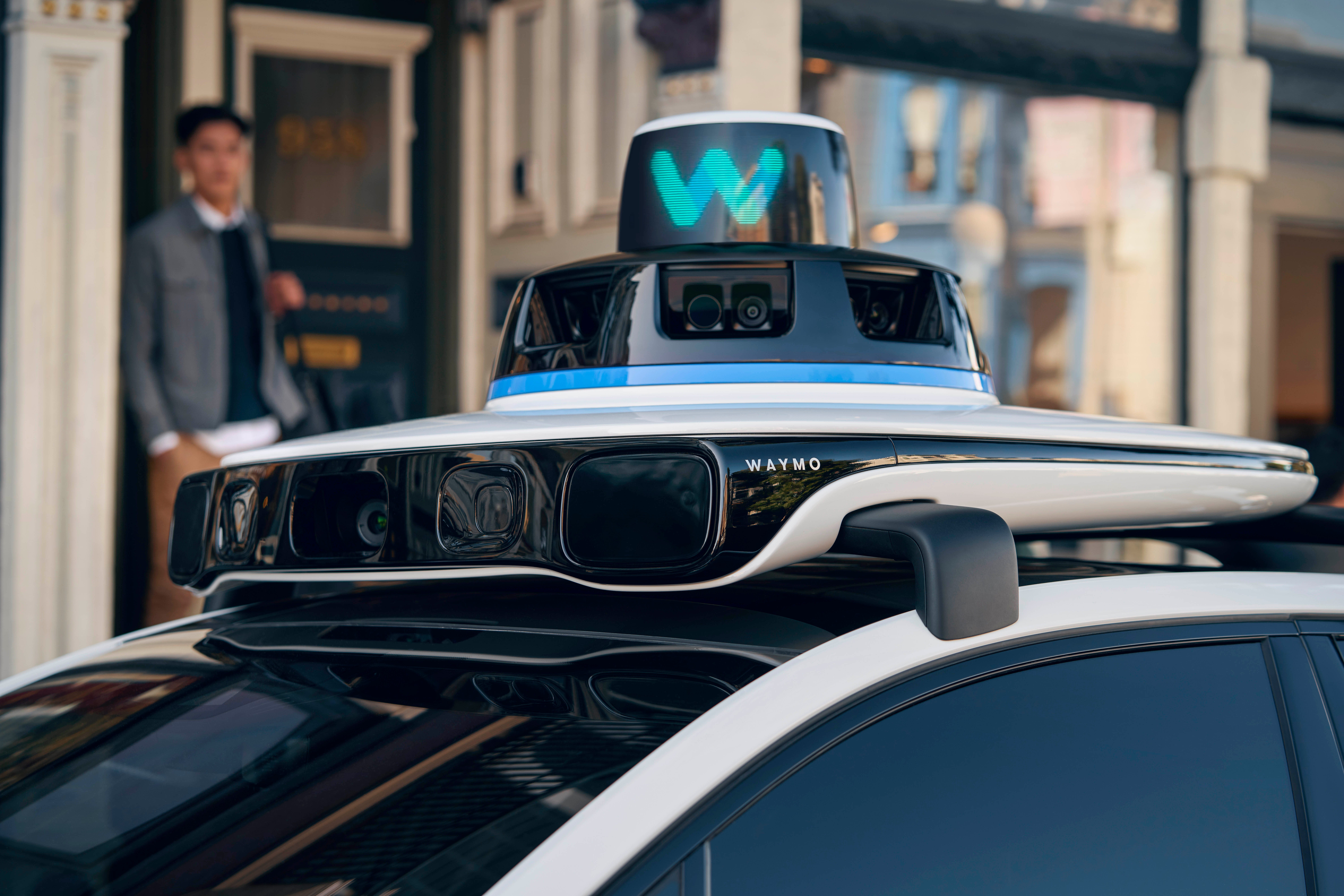
On a trip to Phoenix, my 11-year-old grandson and I took our first ride in a Waymo self-driving car. We watched the car steer itself, carefully, from our hotel to the door of the renowned Pizzeria Banco. It was great fun, as well as a glimpse into the future. As someone who does not like to drive, I would someday love to own a self-driving car of my own.
So, who would not want Waymo in their city? Progressive Democrats, it seems.
New York and Massachusetts do not allow driverless cars. Mayor Zohran Mamdani is no fan of Waymo. The Boston City Council is mostly opposed, and Waymo is meeting resistance in Minneapolis and Seattle.
In Washington, DC., the city government has been “studying” the impact of Waymo since 2022. Janeese Lewis George, a union-backed councilwoman who is thought to be the leading candidate in this year’s mayoral election, says: “I don’t think our city is ready for Waymo at this moment."
It’s another story in red states. Waymo just became available to everyone in Miami and Orlando, FL, and Nashville, TN, after a limited rollout in those cities. It opened in Dallas, Houston and San Antonio in February.
Do you detect a pattern?
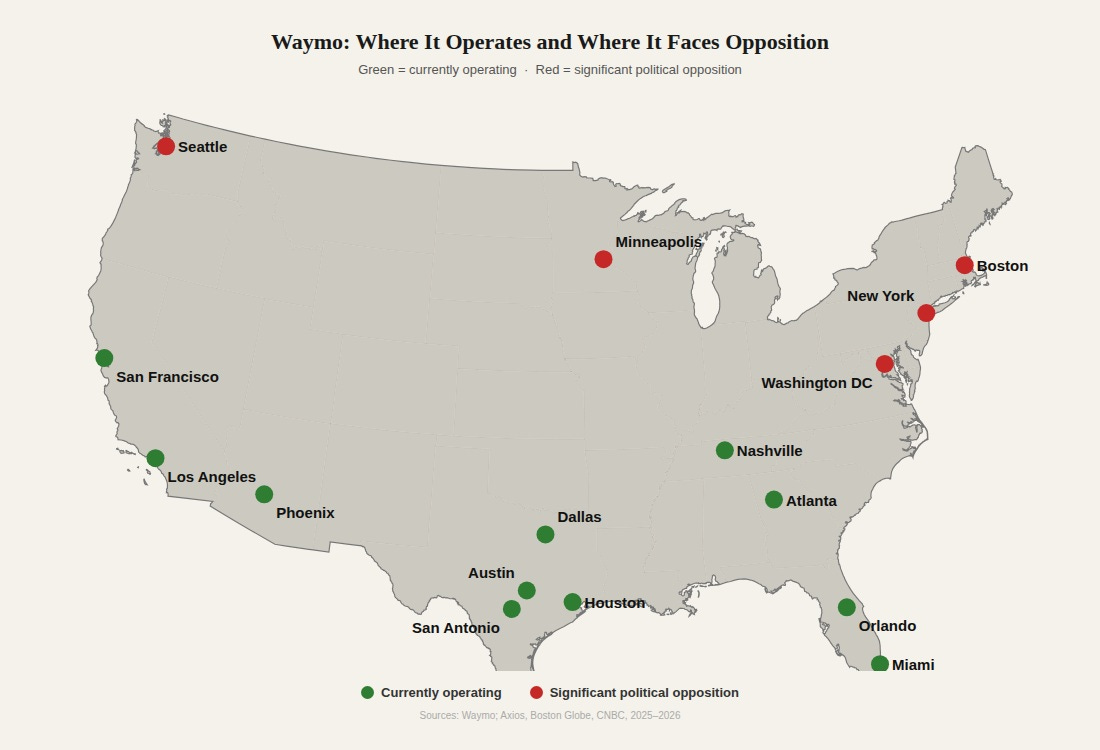
California is the only Waymo-friendly state run by liberals, and that’s only because Gov. Gavin Newsom overcame the opposition of local officials in San Francisco and LA.
At first glance, this is puzzling. Then it’s not. It reflects a mindset.
Liberals worry about new technologies. They distrust big corporations. (Waymo is owned by Alphabet, which owns Google.) They believe that government regulations are more likely than markets to deliver good outcomes. They value safety over freedom.
I’m generalizing, of course, but hear me out.
Liberals opposed nuclear power, the leading source of carbon-free electricity in the US. They opposed natural gas fracking, which went a long way towards replacing dirty coal plants. They opposed food grown with genetically-modified organisms, ignoring the broad scientific consensus that GMOs are safe. They are inclined to regulate social media, which they blame for misinformation, political polarization and mental health problems. And my personal hobby-horse: They oppose e-cigarettes and nicotine pouches, innovations that have been shown to help curb the death and disease caused by cigarette smoking.
Of course, new technologies carry risks, known and unknown. But the risks created by nuclear energy or social media need to be weighed against their benefits, which are often underweighted. Technological progress can create short-term disruption but over time it is a key driver of economic growth, which makes most people—but not all people—better off.
That’s a problem for Waymo. Opponents are worried about jobs. Or unions. (They’re not the same thing.)
Here’s Tom Mari, president of Boston Teamsters Local 25, at a rally last summer when the city council was debating Waymo:
The Big Tech companies putting driverless cars and trucks on our road like to describe themselves as people who are building some sort of utopia, but nothing could be further from the truth. Waymo is steamrolling into cities throughout our country without concern for workers or residents. They’re doing this because they want to make trillions of dollars by eliminating jobs.
More Perfect Union, a nonprofit that does advocacy journalism on behalf of workers, recently published a 12-minute video decrying Waymo and said on X:
If Waymo gets its way, 2 million workers will be out of work. When Waymo gets a firm hold on a city, wages go down. Some drivers now have to work 12 hours day, 7 days a week just to get by. This isn't inevitable — but Big Tech is spending millions to make you think it is.
Boston City Councilwoman Julia Mejia, a hard-line opponent of Waymo, said at a hearing last summer:
Let’s just come to terms with the fact that we are creating a hostile environment for our hardworking people who are no longer going to have work.
All that said, the opposition to Waymo has to be about more than the drivers. After all, Mamdani wants to bring free and fast buses to the city, which sounds great even though, like Waymo, they will take business away from taxi or ride-share drivers. So do the bicycle lanes beloved by progressives.
But buses and bike lanes are not intended to kill jobs. The debate over Waymo gets emotional because self-driving cars are expressly designed to replace human drivers. So are self-driving trucks, which are not far behind.
And looming over the debate is the technology that is quite literally driving Waymo: Artificial intelligence, which threatens to eliminate many millions of white collar jobs. That’s deeply unsettling.
The response can’t be to stand in the way of innovation. That’s a fool’s game. In the 1920s, 12 million Americans worked on farms; we’re a much bigger country now but fewer than three million of us are farmers. Around 100,000 people once worked as elevator operators. More than twice as many were telephone operators.

Let’s try to keep things in perspective. Most workers who lose their jobs get new jobs. The US unemployment rate is about 4.3%, below the historical average of 5.6% to 5.8% since World War II. Waymo currently operates about 3,000 vehicles; there are more than 100,000 taxi and ride-share drivers in New York City alone. The transition to autonomous vehicles will not arrive overnight.
That give us time to start a long-overdue conversation about the government safety net. It needs strengthening and streamlining. If AI creates vast wealth, as promised, that windfall can be used to provide a guaranteed income and health care to people without job, while eliminating the giant, inefficient mess of government anti-poverty programs we have now. That’s a topic for another day.
In the meantime, permitting Waymo to operate in a city or state should be an easy call, and not just for those of us who lean libertarian. Here’s why:
Waymo saves lives. In a peer-reviewed study that looks at 56.7 million vehicle-driven miles in Phoenix, Waymo reports 90 percent fewer crashes causing serious injuries than occur when human drivers cover the equivalent number of miles. Swiss Re, one of the world’s largest reinsurance companies, found Waymo to be much safer than the general driving population, even those drivers in cars with the most advanced safety systems. The evidence is compelling, writes Kelsey Piper at The Argument and the team at the excellent Substack Understanding AI, which dug into the data and found that nearly all of the accidents involving Waymo cars are caused by human drivers.
Waymo delivers climate benefits. The company’s robotaxis are all-electric Jaguar SUVs. They emit neither carbon nor local air pollutants. So long as self-driving cars replace taxis, Ubers, Lyfts or private vehicles, that’s good. If they become so popular that they replace public transit or induce suburban and exurban sprawl, what’s called the rebound effect could undermine those benefits. But we’re a long way from there.
Waymo doesn’t discriminate. Uber and Lyft drives have been known to give people with disabilities poor ratings because they can take longer to pick up and drop off. Someone I know saw his Uber rating fall when he sustained a running injury that required him to use crutches.
Waymo offers choice. Choice is good! People who want to ride in taxis or order an Uber or Lyft will be free to do so. Many will, including people who may need help getting into or out of cars. Those of us who don’t enjoy chatting with strangers can opt for Waymo. So, we can hope, will women at the end of a long night of consuming alcohol. Uber received a report of sexual assault or sexual misconduct in the United States almost every eight minutes on average between 2017 and 2022, according to The New York Times.
Most important, Waymo takes us closer to the day when self-driving cars and trucks are available to all of us. (Tesla and Zoox, which is owned by Amazon, also offer robotaxis, but on a much smaller scale.) The most powerful testimony at the Boston City Council hearing came from a man named Carl Richardson, a disability-rights activist who is almost completely blind.
He’s grateful for Uber but says that “at least once a week I get denied access to Uber and Lyft because they refuse to take me because I have a service dog.” (The Justice Department has sued Uber, alleging that it discriminates against people with disabilities.) “Autonomous vehicles are a big deal to me,” Richardson says, “because I want that feeling that I used to have when I drove. Of freedom and independence and mobility.”
He told P.J. Vogt of the podcast Search Engine that he’s saving up to own a personal self-driving car:
If they ban autonomous vehicles, then they’re going to ban me from the right to drive, earn a living, go to school, go to medical appointments, go to the beach on a Sunday, go visit my mom in a nursing home, whatever, with the flexibility that everybody else has.
For what it’s worth, I hope Carl Richardson someday gets his own self-driving car.
Listen, I get the fear about job loss. I worked for 35 years as a reporter for newspapers and magazines. That afforded me a front-row seat to watch as digital media absolutely crushed print journalism. It caused a lot of pain.
So, yes, we can and should talk about ways to help people who are without work, for whatever reason. But, for goodness sake, don’t slam the brakes on Waymo.
Thanks Mark, I really appreciate this piece! I don't follow this topic super closely, but have been extremely baffled by the opposition to Waymo by people who are quite reasonable on other topics such as THR. One person I know completely reversed their previously favorable opinion on driverless cars (I suspect because of their feelings towards Elon Musk and Tesla) without even acknowledging the change of opinion!
I admit to having a fear of driverless cars, one based on a pedestrain fatality from several years ago. But a quick Google search revealed a peer reviewed article concluding that Waymo accidents have a significantly lower accident rate per million miles driven than humans. See abstract attached.